The Game

I am on a remote Japanese volcanic island. I have chronic fatigue, it is 30 degrees and 85% humidity, and I have barely eaten due to a throat disorder. Yes, the trip was ill-advised. I forgot to pack a USB charger and needed one or face days of boredom in an aircon room, not even a device to write on. So I undertook a three hour early morning adventure, to visit every supermarket on the island, to get the device.

My diet recently had been trivial and poor, and I am not good in humidity. I walk out of yet another supermarket, failing in my mission, and I get sudden onset (isn’t it always?) diarrhea. I suspect the water I drank..

This is pivotal. Many days into my trip I have never seen a public toilet. At this critical juncture, an hour from my lodging, 20 meters away, is such a thing. With an abundance of loo roll. I am saved, but my luck feels contrived. I get to thinking…

There is a video game called Dark Souls that is so notoriously difficult, you get can tips from previous players on how to defeat the enemy. It crossed my mind that previous people playing “me” told the game simulation that a toilet should be there.

And then everything made sense.

Our world is a multiplayer role playing game, where one go is a full lifetime. It is a game, we choose it, and we are back to normal at the end, whatever that is.

Whether by design or not, all players are autistic. Could just be that we are not native and have difficulty fitting in. Or our ways are too hard to program for non-player characters (NPGs).

So that is rule / proof #1, all players are autistic, diagnosed or not. We are not talking rocking in the corner drooling autistics…

The setup is classic fantasy RPG. You choose a game/world/era and a character type and maybe an aim/goal. Elon Musk might have simply chosen nerd intelligence, but he might also have chosen a goal of world domination.

Autism is seen to be genetic because we start the game as the child of an autistic. The relationship is multi-faceted. We are seeded with the looks etc of the parent. Their game goal is the same as ours, or can inform ours. Or their side quests can. My Dad in NZ took on corporations twice and won. I think, as of now, that is my goal. But his main mission was genetics. He wanted to create the best X. He won, creating the world’s best kiwi fruit. He failed breeding a Melbourne Cup winning horse.

All being autistic helps finding other players, although I am perhaps the only person to have understood that…

In a fantasy RPG a lot of action happens at the Tavern. The servers and so on are NPGs but players get to meet and perhaps band together. I have been frequenting a bowls club for decades that is essentially a tavern, with games, and a large percentage of regulars are autistic.

My only serious job was in a digital marketing corporation. It was full of autistics. Paths exist through them.

Like sophisticated games, we always end up in the scripted places, despite the illusion of free choice. I have long considered that no matter where in the world I went (I travelled a lot when young) and what I did, the early Internet would attract me and Google Ads would be my career. Also guaranteed was that I would help out in the Google Ads help community. This in turn meant I got to go to annual conferences in different parts of the world (thanks Google!) and the side missions that came with them. I got a free trip to Tokyo, and my side quest was to camp in the crater of an active volcano on Aogashima. Quest completed!

Prior side quests have been Cambodia, Svalbard, Lithuania and Nepal.

The Google angle also aligns with my game aim – take down evil corporations. This is interesting on two fronts. One, a simple game cannot have this goal unless it uses war and violence. It needs a massive setup and complexity. A lifetime. So I am guessing all such game goals cannot be an achieved in a simpler game. Or else we would be playing the more simple game instead.

Two, winning must be achievable, or else there is no point in playing. This now heartens and inspires me. I’ve already run a global doomsday cult from my bedroom so I know anything is possible. In the “real world” we don’t know how achievable the goal should be. Could be 90% could be 1%. But it is our main purpose here. Even if we don’t consciously know it.

I have had helpers along the way, NPG helpers who aren’t just shopkeepers but exist to help me and me alone. Women who have loved me but as a redirection. No matter which path I took, there would always be a woman luring me to Australia.

At the marketing agency a sexy young woman (I was 50) latched onto me. It made zero sense until now. She genuinely shifted my being into better directions.

Prior to that was Joel from Oklahoma. A lumbering behemoth of a man, think Hagrid from Harry Potter, walks leaning backwards to counterbalance his belly, shirt untucked and chewing tobacco. He approached me randomly and would not take no as an answer. He and I needed to get rich, and we did. Thinking back, the scenario was insane but in the context of a magical helper in a game, it works.

Two types of NPCs. Common, the sort in games who mumble the same thing every time you go near them, and walk away. And those who instruct and guide you. I would guess there are other types, like media personalities who are not players but play a role.

This is a stretch but generally with relationships they leave me (could be after many years). Could be that their guidance was done.

Something that intrigues me is the years on offer in this game. When did backstory end and the game commence. In this particular run of the game, are all famous, pivotal people, players? Leonardo, Einstein, Hitler?

And what is it mapped on? Actual history from our real world? Or some elaborate celebrated fiction?

Soon I will take DMT and meet the alien overlords and I sense this is a key part of the game. We will see.

There is perhaps a team aspect to this game. Pleasing the simulation overlords. If we collectively displease them (global outcomes, not worship) then the game ends for all of us. Big picture this is a simulation, with real random inputs, to find the longest lasting society.

Some motor racing games have ghosts and, back to Japan, I experienced this. Someone who seemed to be a recreation of someone who raced the same track, so to speak.

This is Aogashima, a crazy far-off Japanese island that is basically just a volcanic caldera with a rare smaller caldera inside it. That is where I camped, in the middle of the green. The port is on the far left and the town (170 nutjobs) is top right.
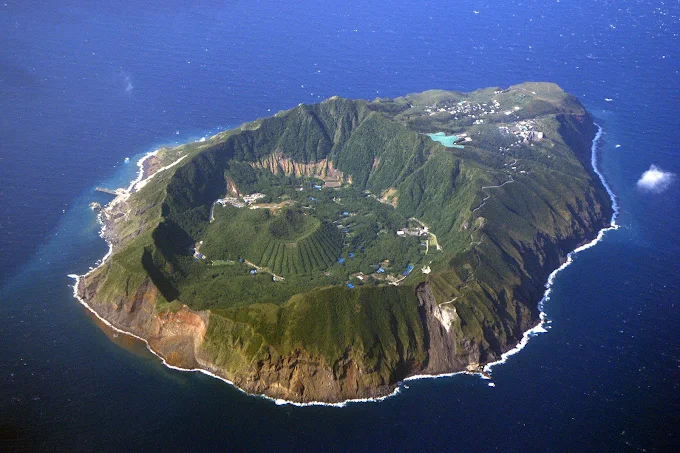
Nutjobs because in the 1700s half the people there died when it erupted. It is an active volcano and there is nowhere to run…

So, the ghost. Early 20s, Japanese chap, one of only four other passengers arriving that day on the ferry.

Or, and the side mission. Nobody on the island speaks English. Accomodation is sparse and can only be booked over the phone. But camping right on the edge of the inner caldera is allowed. So I took a tent.

Walking from the ferry wasn’t too hard. There is a tunnel through the major caldera’s wall. Perhaps 30 minutes and a 50 metre ascent. But I am old and chronic fatigue and 85% humidity and so I stopped halfway and took a little break. My ghost strides past me, waves. Not so strange that he was setting up his tent when I got there, because there was nothing else to achieve.

Here’s where it goes daft, although conceivably just a big coincidence. I had run out of water, the last two vending machines were broken, and I need water or perhaps death could be the result. We were nearing the lethal wet bulb temperature number. And the only store in in the town and it is a 300 metre ascent (there is a road).

I set off and it was very difficult and taxing. Sometimes I stopped every 100 metres to get my breath back. Took around 90 minutes. I found the store, bought supplies and water, sat on a park bench at ate a little tub of Haagen Daaz. Halfway through my ghost turns up and sits next to me and eats and ice cream. No conversation.

Predictably he follows be back down, and the next day walks the same journey back to the ferry. When we arrive in Hachijojima he takes the same walking journey as many for a few kilometres and then exists stage left.

Enough to get me thinking I am in a video game, certainly not proof.

Flying home from Tokyo a 20-ish young lady sits next to me for in the window seat for the 10 hour journey. We never make eye contact, she never leaves her seat. Very unusual! What a bladder! She chooses the same meals and drinks as me.

Catching the SkyBus from Melbourne Airport, guess who sits next to out of 40 passengers. Zero acknowledgement from her that, wow, same same! When she walks next to be at the train station I take action and divert, to end the craziness.

Japan tends to have glitches when I visit and it also seems to have a major ratio of autistic people. It is perhaps for some reason where a lot of players choose to be “born”.

Donald Trump Could End the World

That is, if we live in a simulation, which many smart people think is the most likely possibility…
Potentially, our simulation costs a lot to run. Which means they want it to succeed in whatever its mission is. It also means that if the simulation becomes stuck/broken and cannot be fixed, then they might choose to pull the plug.
One angle they could measure failure by is novelty. If too many changes start happening, they could conclude the result will become too off the rails. And Trump is making a lot of changes. He is making our world unstable. That could trigger something in the simulation software.
If they simply switched us off, we would never know. However, they might not want to waste the opportunity to see how we react to impending doom. So potentially the simulation will introduce a deadly asteroid, a worst-ever pandemic, a super-volcano, an alien invasion, zombies… And see what happens.
And that, to my reasoning, will be the proof we need.

NPCs Cause Fads

They are programmed to be “normal”. So whenever something trends popular, they jump on board and it becomes more popular. Feedback effect.

Even illnesses and ailments. Perhaps ADHD… Perhaps chronic fatigue.

We accept fads, trends and fashions as simply being an aspect of society, but what if it is not natural.

Only real players can read this post, because NPCs are programmed to not consider they live in a simulation. So I am asking you – do you reckon you follow fads and fashions less that the average person? If so, we could be on to something!

Note: that doesn’t mean something popular doesn’t deserve to be so. NPCs don’t start anything new, ever. But they can amplify something that is trending.

They Keep To Themselves

I think a way to crack any existential puzzle is to have as many disparate inputs as possible, and absorb it all. I was just watching Stranger Things and simulation theory popped into my head. Meanwhile non-player characters cannot be found out…

It is hard to believe that every NPC is totally unique, like us real people. Inadequacy in the design process, efficiencies, or simply hubris could cause them to have shared traits or commonalities.

Which would have been fine 100 years ago, but today such similarities are more easily discoverable, if the data is available.

In anticipation of the technology – not hard, it turned up in many other simulations – they may have designed the NPCs to not be very social and sharing. Possibly they hide behind a cult like Scientology (or golfers, or cyclists), hiding in plain sight, or possibly they just don’t show up on the radar.

You know how the neighbours of a terrorist thought they kept to themselves, but otherwise seemed nice enough? Maybe all violent extremists are NPCs?

What if hundreds of NPCs loved eating octopus, read every James Bond fan-fiction and never tied their shoe-laces? If they shared all of these things in the socials, or even “private” online chats, that could be discoverable. Easiest just to program them to live a quiet, mostly hidden life.

So, any friends or acquaintances who “aren’t into social media” are worthy of suspicion.

But also, some NPCs may be placed here as a catalyst, like Shakespeare or Darwin. And they seek attention absolutely.

Real players are likely in-between. And would be the only people to read this.

DILF

I’ve been visiting/looking after my kids, part of a random shared parenting arrangement.

Driving through the resort, the kids point out a guy – standing next to his $180K ute – who their Mum says is a DILF. And he looks it.

Thing is, most of the time in and out out of the resort – Daddy Uber – he is in the same spot doing the same thing. Instead of like, working.

I mention The Truman Show to the kids and they were made to watch it at school!

I might drive in and out a few more times than normal, to check. But of course in a simulation they will know I typed this

Timeliness

This is a very unusual and perhaps unique thought – the simulation might conspire to make things happen in a timely manner.

Context: I regularly make a 90 minute drive. Typically I listen to the radio and when a song bores me, I start a CD. Not a CD I know well, but a CD randomly pulled from a box of CDs I have not listened tp in decades.

I haven’t looked at track listing, and have no idea of how long the album plays for. Although, obviously, it will be within a range of like 30 mins to 80 mins.

So I listen the the album and – I think 5 times now from 30 journeys – when I arrive home and park, the moment I pull the parking brake the last track finishes precisely then.

Uncanny and no way I can cause it to happen.

Last weekend I attended an expo which had lots of talks. The first we wanted to attend was at noon. Google Maps said it was a 3 hour drive so I allowed 4 hours. I went to pick up my girlfriend at 8 but she was 12 minutes late. Our journey included a detour to see a town (but couldn’t find it), and 20 minutes of a wrong turn and backtracking, and a fuel and coffee stop. By the time we dealt with the queue to get in, and the parking, and finding the tent, we sat down to watch the talk. And the moment we sat down my watch ticked over from 11:59 to 12:00.

I’m not intending to convince anyone, just showing where I am coming from.

If we live in a Truman Show existence, then maybe the system contrives to make us turn up at the right time, by putting obstacles in our path, or whatever.

Something to try and notice.

Diamonds & Salmon

The nicest things from nature cost the most!

No, of course not, flowers are wonderful and grow for free. 

Some of the nicest things from nature cost the most!

Diamonds are rare. Muck is common. Do we like diamonds because they are rare, and that is the only reason? Would we like muck if it was rare, and pay $50K per kilo?

It is complicated!

My guess is that truffles and caviar are seen as delicious because they are expensive. And we know things like salt used to be very expensive.

But you don’t need many tweaks to gamify a world. Often just one thing that we are told to desire will suffice. In games like Fortnite it is outfits. My kids have had hundreds of outfits but desire the expensive ones they don’t have, that to my eye are no different. And makes the developers hundreds of millions.

Maybe diamonds are intended to be the goal in our simulation. Regardless of how things actually turn out, our world is different to other simulations by only three factors:

  • diamonds exist naturally
  • they are rare and hard to attain
  • we think they look amazing

Someone from another simulation will think they look like a pebble.

So maybe there is a single thing that this world has unique, to randomise the outcome. It doesn’t have to be what we end up desiring for all time, but most likely will be at least for part of our evolution and history.

It could be anything we have ever fought over, like salt and gold. Or it could be something that is really similar to cheaper versions, but we prefer the expensive one, like salmon.


Easter Egg at the Bottom of the Ocean?

So imagine if our creators decided that a certain level of technological advancement was required before we could discover that we are not actually real.

That could look like a symbol, sign or something clearly un-natural:

  • on something very small (requiring advanced magnification)
  • on something out in space
  • at the bottom of the ocean (which we still find very hard to get to, and dark!)

And it could be in multitudes, or just one instance, the latter meaning we would need to be full scanning and mapping and analysing everything.

Scanning sea-floors could be great for archaeology as well, given that a lot of land has been submerged since we became a modern species. Telling the difference between what was made by us, or our creators would be hard, so I only expect such an Easter Egg to be at the bottom of the deepest parts of our oceans.

They could make it doubly tricky, like only somewhere remote, and you need to use a scanning electron microscope to see it…

Tardigrades and Quantum Entanglement

I’ve had two opinions around quantum entanglement:

Simulation: An algorithm decides how small something should be to show it, depending on whether someone is watching or not. Just like how a video game doesn’t render anything off-screen, because there is no point and it wastes processing power.

Non-simulation: I always though it was a factor of size and being an object made from a single element.

Turns out a creature can be observed in a quantum entangled state:

In the experiment, researchers placed a tardigrade tun on a superconducting qubit and observed coupling between the qubit and the tardigrade tun via a shift in the resonance frequency of the new qubit-tardigrade system. They then entangled this joint qubit-tardigrade
system with a second superconducting qubit.
https://www.dailygrail.com/2021/12/quantum-tardigrade-scientists-observe-quantum-entanglement-in-a-multicellular-living-creature-for-the-first-time/

So, I consider this to be a strong indicator of us in a simulation, unless some scientists can explain it.

Crash the Simulation

Computer programs can crash, and we might be inside a computer program.

So how do we crash it?

Over at Scientific American they argue that we can overload the system by creating our own simulations:

The most obvious strategy would be to try to cause the equivalent of a stack overflow—asking for more space in the active memory of a program than is available—by creating an infinitely, or at least excessively, recursive process. And the way to do that would be to build our own simulated realities, designed so that within those virtual worlds are entities creating their version of a simulated reality, which is in turn doing the same, and so on all the way down the rabbit hole. If all of this worked, the universe as we know it might crash, revealing itself as a mirage just as we winked out of existence.

To me this fails because we have our own real world constraints of computing power and storage to deal with first. We would need unlimited computing power and storage here to stack overflow the system that runs our simulation.

My personal theory is that quantum mechanics, where we can only tell the status of a particle if we observe it, is an indicator of resolution limits of out simulation. Maybe if we observe enough quantum particles at once, we will either crash the system, or quantum mechanics will start acting differently, proving we are in a simulation.

Then there is the impossible to answer ethical question – is it wrong to crash the simulation? If we are not “real”, then no harm done. But if we experience life or even consciousness, despite not being real, should that be protected or even sacred?

Breaking the simulation would be like death, I expect. Once you achieve it, you’ll never know what comes next.

But if there is a restore point, would we as conscious individuals experience that reboot, or would be cease to exist?