Honestly, this whole thing has given me a lot of insight into the fifth-dimensional beings that trapped my brain in one of their computers. Seems fun. I hope they load up a new program for me to explore.
Plenty of people are interested in simulation theory. My kids even call some other kids (cruelly) NPCs.
But it is rare to see someone suggest that it is controlled by fifth-dimensional beings, as I also do.
I am on a remote Japanese volcanic island. I have chronic fatigue, it is 30 degrees and 85% humidity, and I have barely eaten due to a throat disorder. Yes, the trip was ill-advised. I forgot to pack a USB charger and needed one or face days of boredom in an aircon room, not even a device to write on. So I undertook a three hour early morning adventure, to visit every supermarket on the island, to get the device.
My diet recently had been trivial and poor, and I am not good in humidity. I walk out of yet another supermarket, failing in my mission, and I get sudden onset (isn’t it always?) diarrhea. I suspect the water I drank..
This is pivotal. Many days into my trip I have never seen a public toilet. At this critical juncture, an hour from my lodging, 20 meters away, is such a thing. With an abundance of loo roll. I am saved, but my luck feels contrived. I get to thinking…
There is a video game called Dark Souls that is so notoriously difficult, you get can tips from previous players on how to defeat the enemy. It crossed my mind that previous people playing “me” told the game simulation that a toilet should be there.
And then everything made sense.
Our world is a multiplayer role playing game, where one go is a full lifetime. It is a game, we choose it, and we are back to normal at the end, whatever that is.
Whether by design or not, all players are autistic. Could just be that we are not native and have difficulty fitting in. Or our ways are too hard to program for non-player characters (NPGs).
So that is rule / proof #1, all players are autistic, diagnosed or not. We are not talking rocking in the corner drooling autistics…
The setup is classic fantasy RPG. You choose a game/world/era and a character type and maybe an aim/goal. Elon Musk might have simply chosen nerd intelligence, but he might also have chosen a goal of world domination.
Autism is seen to be genetic because we start the game as the child of an autistic. The relationship is multi-faceted. We are seeded with the looks etc of the parent. Their game goal is the same as ours, or can inform ours. Or their side quests can. My Dad in NZ took on corporations twice and won. I think, as of now, that is my goal. But his main mission was genetics. He wanted to create the best X. He won, creating the world’s best kiwi fruit. He failed breeding a Melbourne Cup winning horse.
All being autistic helps finding other players, although I am perhaps the only person to have understood that…
In a fantasy RPG a lot of action happens at the Tavern. The servers and so on are NPGs but players get to meet and perhaps band together. I have been frequenting a bowls club for decades that is essentially a tavern, with games, and a large percentage of regulars are autistic.
My only serious job was in a digital marketing corporation. It was full of autistics. Paths exist through them.
Like sophisticated games, we always end up in the scripted places, despite the illusion of free choice. I have long considered that no matter where in the world I went (I travelled a lot when young) and what I did, the early Internet would attract me and Google Ads would be my career. Also guaranteed was that I would help out in the Google Ads help community. This in turn meant I got to go to annual conferences in different parts of the world (thanks Google!) and the side missions that came with them. I got a free trip to Tokyo, and my side quest was to camp in the crater of an active volcano on Aogashima. Quest completed!
Prior side quests have been Cambodia, Svalbard, Lithuania and Nepal.
The Google angle also aligns with my game aim – take down evil corporations. This is interesting on two fronts. One, a simple game cannot have this goal unless it uses war and violence. It needs a massive setup and complexity. A lifetime. So I am guessing all such game goals cannot be an achieved in a simpler game. Or else we would be playing the more simple game instead.
Two, winning must be achievable, or else there is no point in playing. This now heartens and inspires me. I’ve already run a global doomsday cult from my bedroom so I know anything is possible. In the “real world” we don’t know how achievable the goal should be. Could be 90% could be 1%. But it is our main purpose here. Even if we don’t consciously know it.
I have had helpers along the way, NPG helpers who aren’t just shopkeepers but exist to help me and me alone. Women who have loved me but as a redirection. No matter which path I took, there would always be a woman luring me to Australia.
At the marketing agency a sexy young woman (I was 50) latched onto me. It made zero sense until now. She genuinely shifted my being into better directions.
Prior to that was Joel from Oklahoma. A lumbering behemoth of a man, think Hagrid from Harry Potter, walks leaning backwards to counterbalance his belly, shirt untucked and chewing tobacco. He approached me randomly and would not take no as an answer. He and I needed to get rich, and we did. Thinking back, the scenario was insane but in the context of a magical helper in a game, it works.
Two types of NPCs. Common, the sort in games who mumble the same thing every time you go near them, and walk away. And those who instruct and guide you. I would guess there are other types, like media personalities who are not players but play a role.
This is a stretch but generally with relationships they leave me (could be after many years). Could be that their guidance was done.
Something that intrigues me is the years on offer in this game. When did backstory end and the game commence. In this particular run of the game, are all famous, pivotal people, players? Leonardo, Einstein, Hitler?
And what is it mapped on? Actual history from our real world? Or some elaborate celebrated fiction?
Soon I will take DMT and meet the alien overlords and I sense this is a key part of the game. We will see.
There is perhaps a team aspect to this game. Pleasing the simulation overlords. If we collectively displease them (global outcomes, not worship) then the game ends for all of us. Big picture this is a simulation, with real random inputs, to find the longest lasting society.
Some motor racing games have ghosts and, back to Japan, I experienced this. Someone who seemed to be a recreation of someone who raced the same track, so to speak.
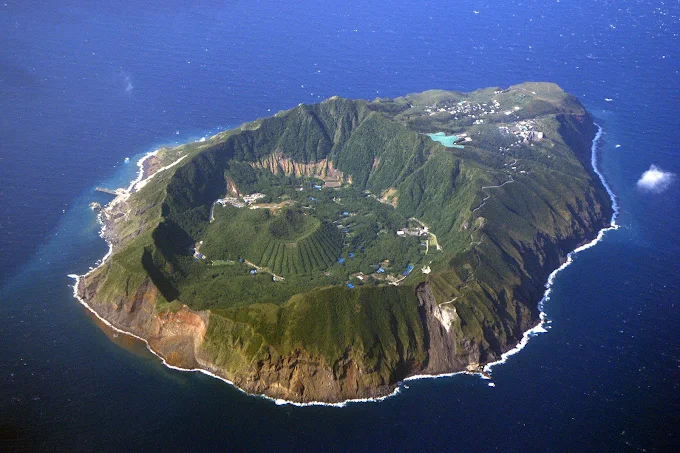
This is Aogashima, a crazy far-off Japanese island that is basically just a volcanic caldera with a rare smaller caldera inside it. That is where I camped, in the middle of the green. The port is on the far left and the town (170 nutjobs) is top right.
Nutjobs because in the 1700s half the people there died when it erupted. It is an active volcano and there is nowhere to run…
So, the ghost. Early 20s, Japanese chap, one of only four other passengers arriving that day on the ferry.
Or, and the side mission. Nobody on the island speaks English. Accomodation is sparse and can only be booked over the phone. But camping right on the edge of the inner caldera is allowed. So I took a tent.
Walking from the ferry wasn’t too hard. There is a tunnel through the major caldera’s wall. Perhaps 30 minutes and a 50 metre ascent. But I am old and chronic fatigue and 85% humidity and so I stopped halfway and took a little break. My ghost strides past me, waves. Not so strange that he was setting up his tent when I got there, because there was nothing else to achieve.
Here’s where it goes daft, although conceivably just a big coincidence. I had run out of water, the last two vending machines were broken, and I need water or perhaps death could be the result. We were nearing the lethal wet bulb temperature number. And the only store in in the town and it is a 300 metre ascent (there is a road).
I set off and it was very difficult and taxing. Sometimes I stopped every 100 metres to get my breath back. Took around 90 minutes. I found the store, bought supplies and water, sat on a park bench at ate a little tub of Haagen Daaz. Halfway through my ghost turns up and sits next to me and eats and ice cream. No conversation.
Predictably he follows be back down, and the next day walks the same journey back to the ferry. When we arrive in Hachijojima he takes the same walking journey as many for a few kilometres and then exists stage left.
Enough to get me thinking I am in a video game, certainly not proof.
Flying home from Tokyo a 20-ish young lady sits next to me for in the window seat for the 10 hour journey. We never make eye contact, she never leaves her seat. Very unusual! What a bladder! She chooses the same meals and drinks as me.
Catching the SkyBus from Melbourne Airport, guess who sits next to out of 40 passengers. Zero acknowledgement from her that, wow, same same! When she walks next to be at the train station I take action and divert, to end the craziness.
Japan tends to have glitches when I visit and it also seems to have a major ratio of autistic people. It is perhaps for some reason where a lot of players choose to be “born”.
I recently came across this concept in a book on simulation theory and although my world hasn’t changed, the ways in which I now consider how my world exists have multiplied. Literally anything is possible in a limitless universe…
A Boltzmann brain is random particles forming, just for an instant, a brain that has all the memories of a real human, and all the things we think we see and smell and feel at that instant, and a sense that we are real.
That’s it. At any moment we could just be a Boltzmann brain that exists for that moment, and then disintegrates.
This is kinda the same that the real physical potential for a human to walk through a wall once every 100 million years, because all the particles do something odd at once.
For decades I have been reading all there is to know about DMT and self-transforming machine elves. There is a strong possibility that they exist in a higher dimension and somehow taking DMT briefly allows us some contact, even though we cannot understand each other.
There appears to be multiple levels of the contact experience. The first has the elves, it shows us how their world appears (4D and incomprehensible, but some aspects seem familiar). If we manage to pass the induction, some are granted access to the next level, which is where giant praying mantises dissect us in a lab.
Elves and praying mantises, for whatever reason, are representations to make them somehow easier for us to digest. They are not literal.
Alien abductees go through the same sequence, because it is essentially the same process, just accessed differently. We see the aliens, then we get probed or whatever.
A key aspect of this is that for them to “reach” us is not easy. I suspect they are not allowed to do what they do and have found some kind of loophole. One reason for that limitation is possibly that we are they, they are us, we are an experience in a lower dimension and when it ends we are returned to our higher selves. That they can contact us suggests that we are a portion of them and not all of them.
Now to the ant farm. Imagine that every ant is 1% of a human, living in a lower dimension, and only knowing the experience of a life as an ant. When that ant gets squashed, it gets returned to the human who “owned” it. That human can then choose to live that whole experience, like watching it on TV, of the ant’s life.
Now imagine that someone has worked this out, that we have little mini-me ants.And we decide to try to contact them, even though the UN decrees it is unethical. We form secret societies and conduct experiments with ant farms for a million years until we work out how to contact them. Those ants eat a certain nectar that sends them into a space where they can talk to us. They see the world through our eyes, with all the distances and things they have no understanding of. And we talk to them but they have no idea what we are saying, and vice versa.
Here’s the point – those machine elves and praying mantises have theorised that there are higher levels above them, and if they can understand us humans, they might be able to work out how they fit into the whole scheme of things. They want to meet the folk on the next level above them, and so on until we get to the top.
Philosophers have long-debated whether humans have free will. When we look at lesser animals it would seem that they do not – they have set responses to scenarios and with enough computing power (as in enough to predict weather perfectly) we could 100% predict animal behaviour.
But we are special, because we are conscious, and we can override whatever instincts we have, if we want. But then, isn’t that overriding still just instinct, but exponential.
Ultimately everything boils down to physics, including our brain cells, and that can mean a presumption that we are predictable, and the future is pre-determined.
Which means in a simulated human world, there are two ways it can work, to actually get results and insights.
Varying Inputs – tweak all the starting parameters and see how it turns out. That might mean giving Earth 1% more water, or tweaking our ancestral ape DNA.
Randomness – that means running the same simulation with the same starting parameters repeatedly, but introducing randomness at some small junctures, especially when it comes to human decisions. You might only need 0.1% of the population making random decisions once a decade to massively change the ultimate outcome of the world.
Or, of course, a mix of both, but I would suggest that would be counter-productive.
Of course if our simulated selves were making random decisions occasionally, we would not know that, we would think we simply decided. Even if others might point out it is a poor choice.
The problem with random is that it isn’t. Any random number created in the world of standard physics is ultimately predictable. So every time you ran the simulation, that random number would be the same number, causing the same result.
The only way to get around that is using quantum physics to generate the random number. A quantum computer. If the actual world running the simulation has quantum physics, then all good, they can use that with us. But if they don’t, if quantum physics is only something that exists in our simulation, then it is actually programmed and won’t work.
Possibly, maybe, quantum physics lives in the actual world, and our simulation pulls that into out world from outside.
Three possibillities
Real world has quantum, we think we do but it is computed normally
Real world has quantum, and they feed it into our world
Real world doesn’t have quantum, we think we do but it is computed normally
Only #2 means we have at least a pretence of free will in a simulation. Only if we are not in a simulation is true free will possible, which also covers players in our simulation that exist physically outside of it.
Maybe, possibly, the only randomness in our world happens when we here start using a quantum computer random number generator to inform our decisions. And maybe that is what our Simulation Gods are hoping for or expecting. So get to it!
That is, if we live in a simulation, which many smart people think is the most likely possibility…
Potentially, our simulation costs a lot to run. Which means they want it to succeed in whatever its mission is. It also means that if the simulation becomes stuck/broken and cannot be fixed, then they might choose to pull the plug.
One angle they could measure failure by is novelty. If too many changes start happening, they could conclude the result will become too off the rails. And Trump is making a lot of changes. He is making our world unstable. That could trigger something in the simulation software.
If they simply switched us off, we would never know. However, they might not want to waste the opportunity to see how we react to impending doom. So potentially the simulation will introduce a deadly asteroid, a worst-ever pandemic, a super-volcano, an alien invasion, zombies… And see what happens.
And that, to my reasoning, will be the proof we need.
And I mean spiritual in the way a person has spirit, does something spirited. Like leaving their partner or their job, and feeling empowered and vital, at least for a while.
Possibly, when you make those rare, spirited, major decisions in your life, like volunteering in Africa or joining the navy, the universe splits in two, and your spirit can only be in one place, so it follows your spirited decision into the new universe.
The old you stays behind, essentially a clone of you but minus your spirit. That you is unaware that anything happened, aside from a nagging feeling you weren’t bold enough. That shell of you continues on as before, and nobody notices any difference, except for in the long term, and your lack of excitement and excitability is put down to age and just being a normal human who cooperates with what society expects.
Back when we were hunter/gatherers, such spirited decisions happened rarely, maybe to one person, once a generation, in your group. It was rare for a new universe to form, and consequently, within your group, almost all of you were people with spirit. That made an ineffable but powerful difference to your life experience, community bonds, peace, calm, and perhaps your group’s interactions with nature.
As the numbers of humans grew, as we drifted from our birthplaces, as our numbers of connections grew and life became insanely more complicated, then more spirited decisions are made (still perhaps only one or two per person), which meant a constant splintering off into new universes, and few spirited people remaining in yours, with you. Most of the people around you could be seen as NPCs (non-player characters), people operating on autopilot, missing the spark that might draw you to them. This is a negative way of being as a society. Try not to listen to those who are no longer spirited in your universe. Trust that you are still spirited, because for all you know, the non-spirited you that you left behind is incapable of even considering such possibilities, that are not awake enough.
OF COURSE that asks the question, when the new universe forms with the spirited you in it, did other spirited people come along with you? If so, that means that the spiritless you is left behind in a spiritless world, so what is the point?
CONSEQUENTLY this makes no sense in a physical world, and works if we are in a simulation. A new universe can retain every aspect of your old world, and your old world can retain every aspect, expect the you, there, has lost their spirit. In this case spirit is an attribute or ability, as in a RPG, like mana, and not a soul.
All simulations have a computational cost, and it is a reasonable presumption that a universe without much spirit left in it, is turned off. OR, the strength of the required spiritual decision keeps increasing, to reduce the number of worlds running.
Because of video games, whenever simulation theory is discussed, NPCs (non-player characters) regularly come up. In a game they are computer controlled characters, and do not exist outside of what is necessary to progress the game in real time. If, for example, you pay a NPC to construct a barn for you, typically the barn will just appear. All the NPC was needed for in game time was a conversation.
Simulation theory is taking off in the regular world, and calling someone a NPC is a very recent putdown. So it is perhaps a good time to consider whether (if we are living in a simulation) there are NPCs.
I will ignore what non-NPCs are – they could be actual conscious beings playing a game, or simulations based on a real living being, or something in-between. For argument’s sake, when I mention a player, I mean you or me, as we experience life. Presumably NPCs are hard-wired to not participate in simulation theory discussions, so, presumably, you and I cannot be one.
Can you test for NPCs?
In a video game you cannot interview or run tests on a NPC, so this never comes up. But in a real world we can, and it would be strange and noticeable if certain people did not participate in studies that could out them.
We, collectively, regularly complete tests. Schools, driver’s licence, eyesight, medical and so on. So, unless you want to decree that all medical professionals are NPCs, then someone will have noticed if a NPC doesn’t have blood or a brain or whatever. Creating a perfect replica of a player physically takes a lot of processing power.
Possibly, given its intricacy, a NPC declines to have a brain scan. That could be an easter egg. Otherwise, in terms of processing, an NPC is physically identical, and all that could be different is their thoughts.
Difficulty hiding them – variety of actions + circumstances
An NPC with less processing power used on thoughts will be hard to find. Yes, they could be mentally deficient people, but what use would they serve a simulation? Any NPC in our simulation, to avoid being noticeably different, must have describable taste (at least in TV and pop music and fast food), desire to buy products and services, desire to travel (perhaps), fall in love (at least nominally), raise children, perform work (few of us are factory workers these days) and so on. That is a lot of functionality that is the same as a player’s. Possibly, though, you could find people who are somehow limited in all of those aspects – generic people – who live in the suburbs I guess. But nobody has yet.
The other way of looking at this is, what does a player have or demonstrate that a NPC does not and cannot? I have previously suggested artistry and invention. Possibly even just having a questioning mind, and critical reasoning. But if that was the case, how much different – in processing power – would that be from a NPC? I am thinking not much, but it is hard to gauge considering we cannot create any of those with computers ourselves.
All the other animals, fraction of computing power needed
While arguably all animals are NPCs, they greatly outnumber us (many trillions of ants, for example) and that would mean that the fraction of computing power needed for players to not be NPCs is relatively very minor to what is required to run the whole planet.
Why even have them and not fewer people?
We would of course need to prove a need for NPCs. Why even have them instead of fewer people on Earth, all of whom are players?
So, your mission is to:
Find provable, quantifiable things that NPCs cannot do
Find a physical easter egg in NPCs – like a brain scan on someone unwilling
Find a purpose for NPCs (like factory work) that a player cannot or would not do
The other question is, how many players are there? If it was only me, then this could very easily just be a game. No need for blood vessels in a NPC unless I personally need to witness it. If there are billions of players, why even have NPCs?
Personally, if I am to entertain the idea of NPCs then it can only work like this:
Only players can create something new
Only NPCs do the worst of jobs
NPCs switch off when not needed to actually do something (when being told that they did it will suffice)
A physical attempt to prove NPCs – like chopping off someone’s finger to see the blood – will be the only way to know. Anything digital or non-local can be faked.
Blood-letting is a bad example, unless all the criminals and soldiers of the world are players…
This is a pretty simple concept. Similar to the infinite monkeys theorem, which says that if you give them typewriters they will eventually write Shakespeare.
Our simulation could exist to generate content, like movies, music, novels, memes. Whatever takes off here could be popular IRL.
Why does our simulation have cave art from 40,000 years ago? Because the simulations that didn’t were switched off.
As long as we keep pumping out content, the simulation can keep running. Fund the arts!
If we do live in a simulation, then presumably it is one of many, and therefore constraints will be involved.
There will be physical constraints:
Time – while our time could be sped up versus the time of those who run this, there will be limits to how much time can be sped up, and limits on how long the show-runners will want to wait and see the results
Size – even in a future where a realistic simulation is achievable, there will be limits on processing power and data storage, especially if we delve into quantum physics or set up our own simulations
And there will be constraints around the purpose:
Time – when does the simulation start and finish in the years of the simulation? There must be an end-goal, and it there must be finite limits to how long it will run for
Staying on Target – if the simulation goes in an unintended direction, it will need to be adjusted or ended
Which got me thinking about to angles that relate to and might explain what we see happening in our world.
Wars are a feature of modern human civilisations, and we see them as sad, strange, but inevitable. Even when we progress in so many other ways, one mad-mad (Putin) upsets things with a war that only has negative outcomes for all except for one man and his dream of a legacy.
Wars have also been based on religious beliefs a lot, even when the sparring sides believe in the same god, but have differences of opinion around how to worship it/them.
So conceivably, when the world trends towards becoming too homogenous, in culture or belief, the show-runners interfere and create a war. Which suggests that they control our leaders. That might explain why many leaders are so ideologically nice until they actually get into power, and then their ideals fade away.
Pandemics or natural disasters, are often seen as acts of god. Perhaps they truly are? It is entirely possible that there is a limit to the number of players (humans) that our simulation can handle. So maybe we are reaching that hard limit and alongside lower birth rates, we have an engineered pandemic to reduce the global population.
Recently there is a puzzle as to why the excess mortality rates are substantially higher than those attributed to COVID. Quite likely they were simply undiagnosed, or were indirectly caused by the virus, adding to the woes of a body that was already sick, and killing them months after the illness.
Or, perhaps, our show-runners have turned up the mortality dial a bit. More people randomly getting cancer and heart disease, or it becoming more fatal than before.
They need to be careful because some of us in the game might notice that things are not adding up.